
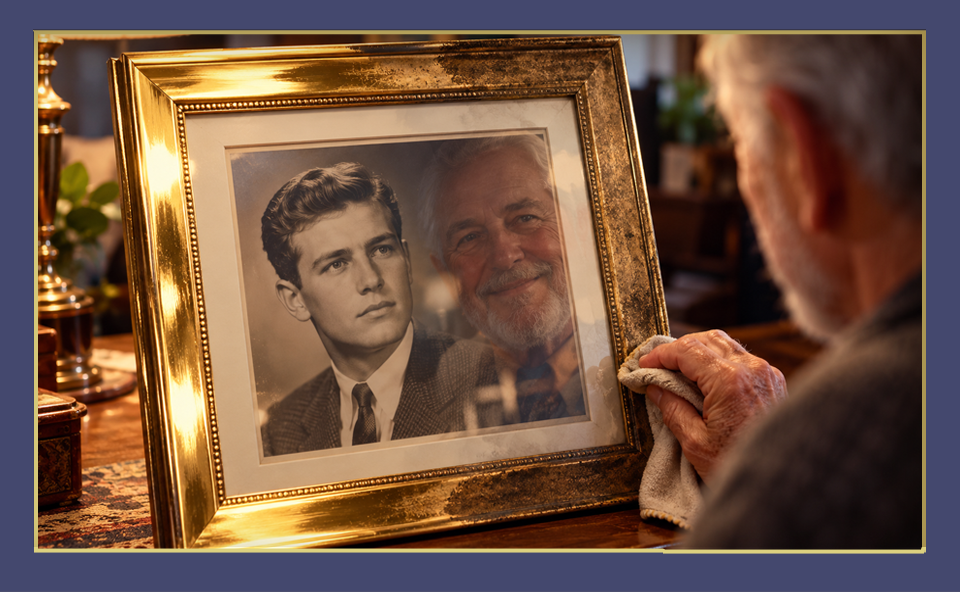
In February 2024, I wrote about the realities of aging. Aging Takes Time addressed the subject as “a process of biology mixed with philosophical uncertainties.” In a subsequent article, Old took a hopeful view of that process, noting that being old is “not a sentence; it’s a book.” Both pieces explored what we gain and lose as we move from being a “junior” citizen to a “senior” citizen. The further we travel through life, the more insights we gather. A little savvy wisdom straight from the horse’s mouth.
Oh, that it were so simple.
In December 2025, I wrote another article that addressed the other side of aging, the one you can fully comprehend only once you’re wearing those shoes. I Don’t Have Time explored the plight of older people who must work past retirement because they cannot afford to stop. I also addressed the physical and emotional challenges that can accompany later life and the social stigmas many older people face.
That leaves a question I have yet to answer: What does aging buy us? Apart from a reduced fare on public transportation or the occasional senior discount, is there anything worthwhile in the bargain? We certainly place a premium on age in other areas. Vintage automobiles, fine wines, rare works of art and archaeological finds that can fetch a king’s ransom. Apparently, if you want to appreciate with age, it helps to be a bottle of wine.
But what about us, nature’s purported crowning achievement? Do we grow in value as we get older? And let me clarify what I mean by value. I don’t want to wait 500,000 years for someone to discover our bleached bones beside an ancient smartphone in an archaeological dig in what used to be called New York City, to finally hear someone exclaim, “This is a priceless find!”
WIVO (Wisdom In – Value Out)
Gauging the monetary value associated with human life is actually a thing. Economists may estimate a person’s future earnings, while government agencies use another measure, the value of a statistical life, to evaluate policies that reduce the risk of death. Those measures serve different purposes. Neither is a price tag on a particular human being.
The Value of a Statistical Life, or VSL, estimates how much people are willing to pay for small reductions in the risk of death. For example: if 100,000 people would each pay US$100 to reduce a fatality risk by one in 100,000, the total would be US$10 million. This does not mean that anyone has assigned a US$10 million price tag to a particular person’s life. It’s simply a tool for comparing the benefits of safety measures.
These are a few of the cold, analytical ways institutions measure the benefits of preventing deaths or the economic contribution of a person. Skills, problem-solving abilities and productivity are useful considerations when allocating resources. But in the grand scheme of life, most of us would agree that our value as human beings lies elsewhere: in our relationships, the decency we show others and the positive effect we have on the people around us. In that sense, a life is priceless.
And yet, society does not always honor that distinction between economic usefulness and human worth. There’s more to being old than mere statistics or the inevitability of aging. Because whether we wish to admit it or not, the opinions, knowledge and insights of older people tend to be overlooked once they reach a certain age.
Groundhog Day
I imagine that my last sentence brought to mind people from earlier generations who have contributed or currently contribute a great deal to society. Names from government, business, sports and entertainment may have appeared on your list. Many had already made their mark by retirement age. But others challenged the idea that opportunity ends at 65. Laura Ingalls Wilder published her first Little House book, Little House in the Big Woods, at 65. Grandma Moses began painting in her late seventies and became widely recognized afterward.
These people and many others are remarkable examples of the adaptability of the human spirit. Yet the roughly 855 million people aged 65 and older worldwide, about 10.5% of humanity in 2025, will not all achieve public recognition. Many would gladly settle for more attention within their own families and communities. Between 2020 and 2025, the global population aged 65 and older exceeded the population aged five and younger for the first time in recorded history. How does a resource of that magnitude go unnoticed?
The numbers alone do not explain the problem; much of it is cultural. Although many societies have honored older people as wise elders, parts of modern Western culture treat aging as if it were a kind of obsolescence. We call people elderly and then surround the term with a series of labels that assume the appearance of dependence, frailty and diminishing usefulness. Too often, those assumptions obscure what older people can still contribute.
In clinical settings, older patients are often less likely to receive life-prolonging treatments (partly in thanks to statistical correlations regarding financial and commercial value) where older people are seen as having lived a full life, or where research shows that an older person’s body would not be able to tolerate certain life-saving treatments. The “Fair Innings” Argument (FIA) by the bioethicist John Harris posits that everyone is entitled to live a reasonable span of life and that all decisions for saving a life are to be weighed equally. Yet as the FIA considers a “reasonable” span of life as one that has reached an age between 70 and 80, an older person who has lived their “fair innings of life” could come under scrutiny when having to allocate scarce healthcare resources. In all fairness, the FIA frequently comes under debate and is usually rejected in medical practice.
There are quieter ways an older person can become invisible. Families may choose retirement communities, assisted living or nursing care for sound financial, logistical and medical reasons. Those decisions are often made with love and necessity, not indifference. But when a move also means the end of meaningful family visits or participation in community life, out of sight, out of mind can become a painful reality. The loss is not only companionship, but a person’s place in the daily conversation.
Even within the creative canon of media and entertainment, popular culture can send the same message, sometimes with a laugh track. Older characters are often reduced to being frail, befuddled or hopeless with technology. Apparently, the moment you qualify for a senior discount, you are also expected to forget how to use your phone. Meanwhile, the full range of older people’s experiences, including work, love, ambition and passion, receives less attention than it deserves.
Where Do We Go From Here?
To be fair, this article is not an indictment of people under 65, nor am I suggesting that everyone over 65 should start perusing the want ads. My argument is that we, as a society, too often overlook one of our most valuable resources. People who have spent thirty to fifty years honing their skills and collecting hard-earned experience deserve, at the very least, our attention and respect.
Consider an unlikely comparison: Salt.
In ancient times, salt was an essential preservative and sometimes a valuable commodity. The English word salary ultimately comes from the Latin salarium, a term associated with payments or allowances and linked linguistically to salt. The familiar story that Roman soldiers were actually paid in salt is much less certain than we have been led to believe. Yet what matters for this analogy is simple: something can be inexpensive in the market and still be indispensable to daily life.
As we move through life, our value is heavily tied to our uniqueness in the labor market and our economic potential. Yet as we retire and are no longer a component of that labor market, we become like salt, a ubiquitous item that says little about our aggregate usefulness. Yet like salt, our value lies in how we carry the essence of a life lived; the spice of our culture, literature, history, and familial memories that add flavor and complexity to the human experience. We don’t devalue with age; we remain a viable resource for those willing to learn from us.
The value of our elders has long appeared in philosophical writings. In Book I of Plato’s Republic, the elderly Cephalus speaks with Socrates about the freedom he has found as his passions have quieted. As Cephalus puts it:
“Old age has a great sense of calm and freedom. When the passions relax their hold, then… we are freed from the grasp not of one mad master only, but of many.”
Cicero also defended the contribution of older people. In On Old Age (De Senectute), Section 17, he compares an older leader to the pilot of a ship, who may sit quietly at the helm while others perform the physical work. Cicero’s point is that age can bring reflection, character and judgment; all forms of contribution that muscle and speed cannot replace.
In more “modern” times, Johann Wolfgang von Goethe was aware of the “Groundhog Day” effect; the reset that occurs when a younger generation chooses to ignore history and instead treats it as though its roots began at the moment of their birth, rendering moot the insights of the older generation. Goethe’s writings contained many reflections and maxims on the subject of aging.
Simone de Beauvoir, the 20th-century French writer and philosopher, examined society’s treatment of older people in The Coming of Age. She argued that the way a society treats its elders reveals the values it truly lives by, and that excluding people when they are no longer economically productive exposes a painful moral contradiction. That by dehumanizing the old, younger generations are actively writing a prescient script for their own future abandonment.
In his book, The Life of Reason (Vol. 1, Reason in Common Sense), George Santayana wrote about the condemnation of those who cannot remember the past. But I think it’s important to read the full measure from where that quote originated. The boldface lettering in the quote is from yours truly:
“Progress, far from consisting in change, depends on retentiveness. When change is absolute there remains no being to improve and no direction is set for possible improvement: and when experience is not retained, as among savages, infancy is perpetual. Those who cannot remember the past are condemned to repeat it.”
I am not suggesting that younger generations should defer blindly to the perceptiveness of their elders. Young minds have driven extraordinary innovations throughout history in the arts, literature and sciences. But new ideas can gain direction and focus from experiences that came before them. There is room for both the daring of youth and the judgment that comes from having lived long enough to see the consequences of earlier choices.
Final Thoughts
I will admit that some of this has been very difficult to write in the current political climate when coming to the defense of the older generation. Respecting experience does not mean excusing poor judgment or placing a gerontocracy beyond criticism. In the United States, we have seen how loyalty to powerful figures can discourage people from asking necessary questions about fitness, accountability and the public good. My argument is for the dignity and value of older people, not an automatic deference to anyone solely because of age.
In 2019, geriatrician Dr. Louise Aronson published a book entitled Elderhood: Redefining Aging, Transforming Medicine, Reimagining Life. She asks us to think of elderhood as a meaningful stage of life, envisioning it as much a part of our lexicon as we think of childhood and adulthood, rather than as a period defined only by decline. The idea offers a more generous vocabulary for the experience I have been describing.
So, what’s the value of being old? In simple terms, it is one of life’s great achievements. We have lived through countless ordinary days that have now become history. Our decisions, mistakes, duties and acts of love have shaped the world our younger generations will inherit, challenge and improve. What once seemed like an unremarkable moment in time can often become a valuable lesson someone else may need decades later.
Being old is to be at the epitome of life. It’s what success looks like when seen through “each wrinkle, each change to our physical form (that) carries with it the visual representation of experience.” It’s the embodiment of evolution at the height of its success.
For those of you who are comfortably north of fifty, take heart in what you have achieved. Even if you feel you have merely wandered through life as a casual observer, you have seen things no book can reproduce exactly as you experienced them. You have witnessed history firsthand, and you bear the memories of its successes and the scars from its mistakes.
And for those of you wondering what life will be like when you are north of fifty, I would suggest spending time with an older person you know. Ask about the ordinary moments that led to unforgettable decisions. Listen to what worked, what failed and what they wish they had understood sooner. The art of aging is as random as it is purposeful. Those who have traveled further along that road may help you recognize where to find a few treasures and how to avoid a few mistakes before they find you.
What you have to say will go a long way…