
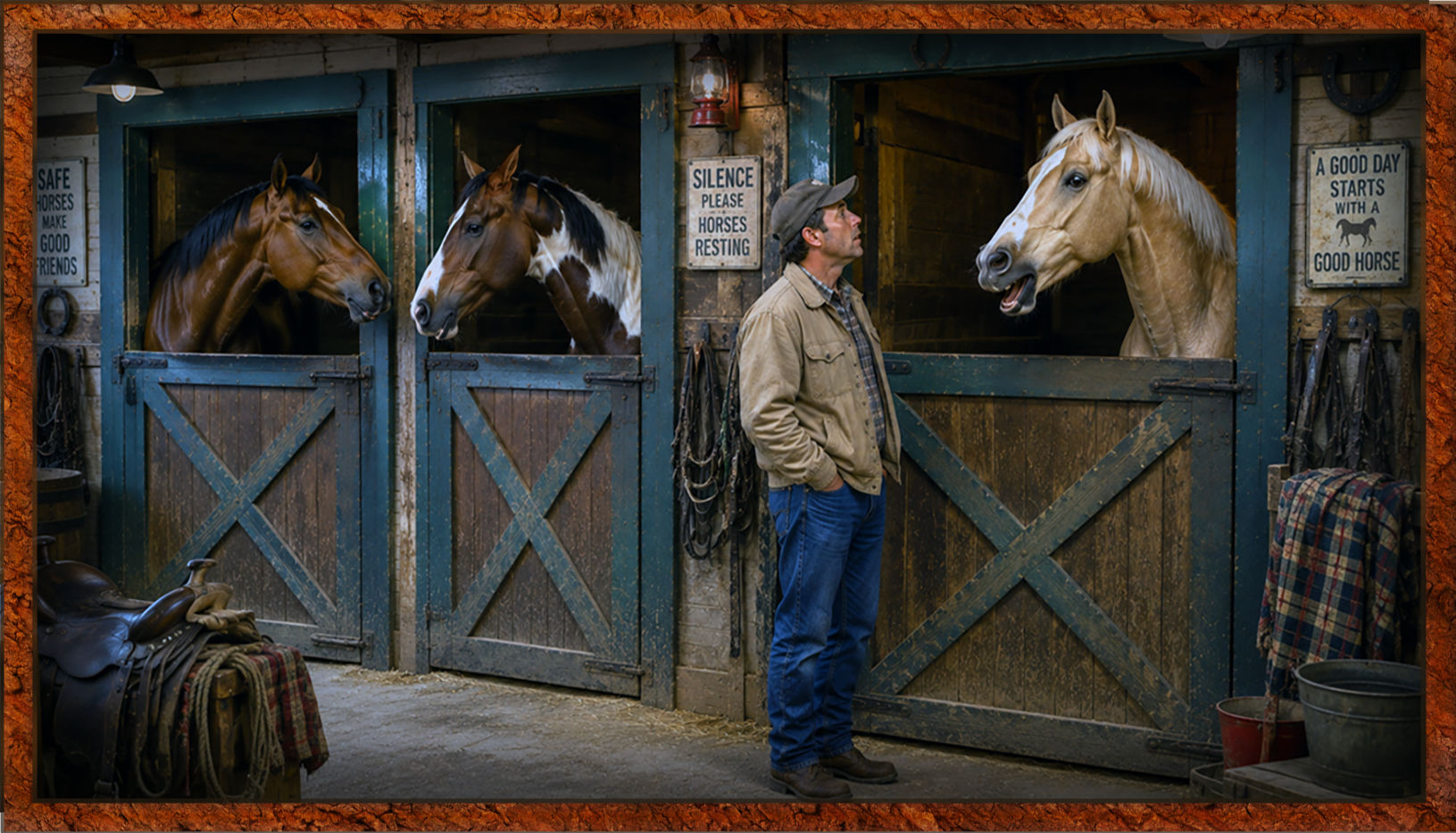
For those of you who may have guessed correctly, I borrowed the title of this article from a popular TV show from the early 1960s entitled Mister Ed, about the misadventures of a talking horse by the same name.
The lyrics to the Mr. Ed’s theme song were written by Ray Evans who had a very successful career as a lyricist. I’m including a more popular verse from the Mr. Ed show for you to enjoy:
A horse is a horse, of course, of course
And no one can talk to a horse, of course
That is, of course, unless the horse
Is the famous Mister Ed.
Why include the lyrics, you ask? Well, because they humorously touch upon the most salient and truthful characteristics of a horse: Their intelligence, personality and their heart. And although there are scores of publications that explain the dynamics of a horse’s emotional intelligence, their abilities for learning and the lasting bonds they establish with people, I wanted to share a few thoughts from the vantage point of someone who learned some indelible lessons from these amazing creatures later in life.
“All Good Things Come From Horses”
As those of you who frequent this site may recall, that statement was said to me by my beloved CeCe within days of having met her. But the true extent of that expression would not make itself known until years later.
At the beginning, I assumed CeCe was referring to some of the social connections that could come about from owning or being around horses. But that was because I didn’t understand the nature of horses beyond them being ridden, raced, or used as beasts of burden. Even my historical knowledge of horses was skewed by how they were depicted in art and then through the idealized lens of Hollywood: Wild-eyed beasts with massively sinewed bodies and flared nostrils that carried men into battle; horses running wild across the prairies during hunts or stampedes; horses doing tricks or pratfalls; horses marching solemnly in parades or funerals to honor the deaths of fallen heroes. Even the expressions used to describe horses and their relationships with humans were fraught with words that spoke of a never-ending battle of wits and will between humans and horses: Breaking a horse, beating a dead horse, straight from the horse’s mouth, hold your horses, back on the horse, champing at the bit, put out to pasture, etc.
“It’s Never the Horse’s Fault”
That was another phrase that CeCe would always say to me since the beginning. Once again, I blithely assumed that she was being a loving ‘mom’ who would never find fault with her ‘child’. But after learning how to ride a horse, that statement began to make perfect sense. And that’s because a horse establishes a partnership with the rider. And in the vast majority of cases, the horse will be attuned to the rider for any directions or commands the rider wishes to do. And they will pay very close attention to what you communicate – even if it makes no sense to them.
I discovered this in a hilarious fashion when I was learning how to ride. I communicated to the horse I was riding that I wanted to move forward at a walk. Great. When we approached a wall, I gave the command to what I thought was to turn right. But I was wrong. So the horse walked right up to the wall and placed his flash (aka his forehead) right on the wall. When I asked the trainer why the horse was acting that way, the horse turned his head around and looked at me with an expression whose intent was crystal clear: “Are you going to ask me to turn, dummy?”
During our years of creating musical freestyles for local and international dressage competitors, CeCe and I had an opportunity to meet some amazing horses. And given my insatiable curiosity, I would spend my time observing how these talented creatures would interact with one another and with the demanding bipeds that surrounded them. In later years when we bought the farm and brought our “kids” home, it provided an amazing opportunity to learn just how horses behaved. Of all the institutions of learning I’ve attended in my life, none were as exhilarating, demanding, complex or rewarding as our little barn.
A Friendship Built on Love
A relationship with a horse is a life-long endeavor. I know that many horse owners, trainers and competitors would argue that point. But I’ve seen them all with their horses, and the vast majority of them related to their horse(s) the way you would with a shiny, new car: It gets you where you want to go, it provides you with status in certain circles, in many cases it can be a profitable relationship, and whenever it gets old, can’t move as well or it just doesn’t suit your needs, you sell it and get a new one. That metaphor best describes the concept of livestock. In my humble opinion, it’s a word that in and of itself is an oxymoron best applied to a Pet Rock. Any living, breathing and sensing creature is worthy of something more.
In an article I wrote in June, I shared my experience with a horse called Wally that completely changed my viewpoint on horses. But it wasn’t until I was living with a horse on a day-to-day basis did I come to understand how deep that relationship could be. Certainly, having been an elementary education teacher gave me a unique perspective as to a horse’s intellect and proclivity for humor, fun and learning. But it was their ability to understand the nuanced aspects of human emotions that was both endearing yet difficult with which to become accustomed.
And that’s because horses can feel your emotions before you even display them, for they are highly sensitive towards body language, vocal intonations and physical tension. A horse can sense when you are in pain; a horse can sense when you’re sad, angry or despondent. These are traits that are essential for a herd animal and have a close correlation to our tribal and social habits. It’s through the repetitive actions of riding, feeding, cleaning and caring for a horse that they develop an attachment with a human companion. Like a small child, the horse will become acclimated to that relationship and will often turn to do something for you in return. Horses are famous for grooming or nuzzling when you’re giving them attention. This is a symbiotic action horses will do for each another, such as when two horses will face in opposite directions while standing close to one another so they may massage each other’s backs.
Horses can sense when you’re in pain and will gently ‘groom’ that general area in an attempt to make you feel better. CeCe was a Reiki Master, and she would often scan a horse to see where they might be in pain. She did that for Charlie once and from then on, every time she came into his stall for whatever reason, Charlie would approach her then use his nose to point to the area of his body where he felt discomfort. CeCe would rub or treat the area for him and he would be as happy as can be, either nuzzling her in return or simply nickering his appreciation. And whenever CeCe went to visit a horse farm where she had given a treatment to one or two horses, you could hear the loud nickering of recognition even before she walked into the barn.
Final Thoughts
The one thing you learn from being around horses over an extended period of time (which for me, was over 20 years), is that you become hyperaware of your environment. You become hyperaware of people. Because when you’re with a horse, you will be subliminally trained to be aware of your environment in ways you probably never considered before. And that’s because horses are aware of everything; it is their way of being and an autonomic mode for survival. They’ll read a neighborhood just as quickly and accurately as you could read a room if you were acclimatized to do so. A horse will sense the overall emotional mood of an environment and choose to walk away if it feels to be toxic or dangerous – even if their human companion is present. Whoever wrote the expression fools rush in where angels fear to tread must have assuredly owned a horse.
This coming January will be a year since Charlie passed away. And whenever I go out to the fields to mow or just go for a walk, I still miss having Charlie come up to me from behind and put his head over my shoulder; his way of saying hello and asking if I wanted company. Because he knew that I did. Had I wished to be alone, he would have sensed that and continued on with his grazing.
In a world filled with unconnected people stressed by the agonies and egocentricities propping up today’s society, such connections are essential for a healthy and peaceful life – regardless of whether they come from a horse, a dog, a cat, a bird, a rabbit, a squirrel and yes, even from another human being.
We are social creatures that rose through our biological growing pains to become connected to one another in nature. So have all creatures on earth; it’s the single most consequential requirement for survival. Horses recognize that better than most people, and they do so even when they acknowledge that it might be a fool’s errand. Because connections are the key to survival. The difference between us and horses is that they do it from a place of collaboration and love, not from profit nor possession.
In deference to Mr. Evans’s lyrics, keep these simple words of advice in mind:
Go right to the source and ask a horse
Or even a friend that you may endorse
The best advice you’ll get, of course
Connect with folks and friends.
What you have to say will go a long way…