
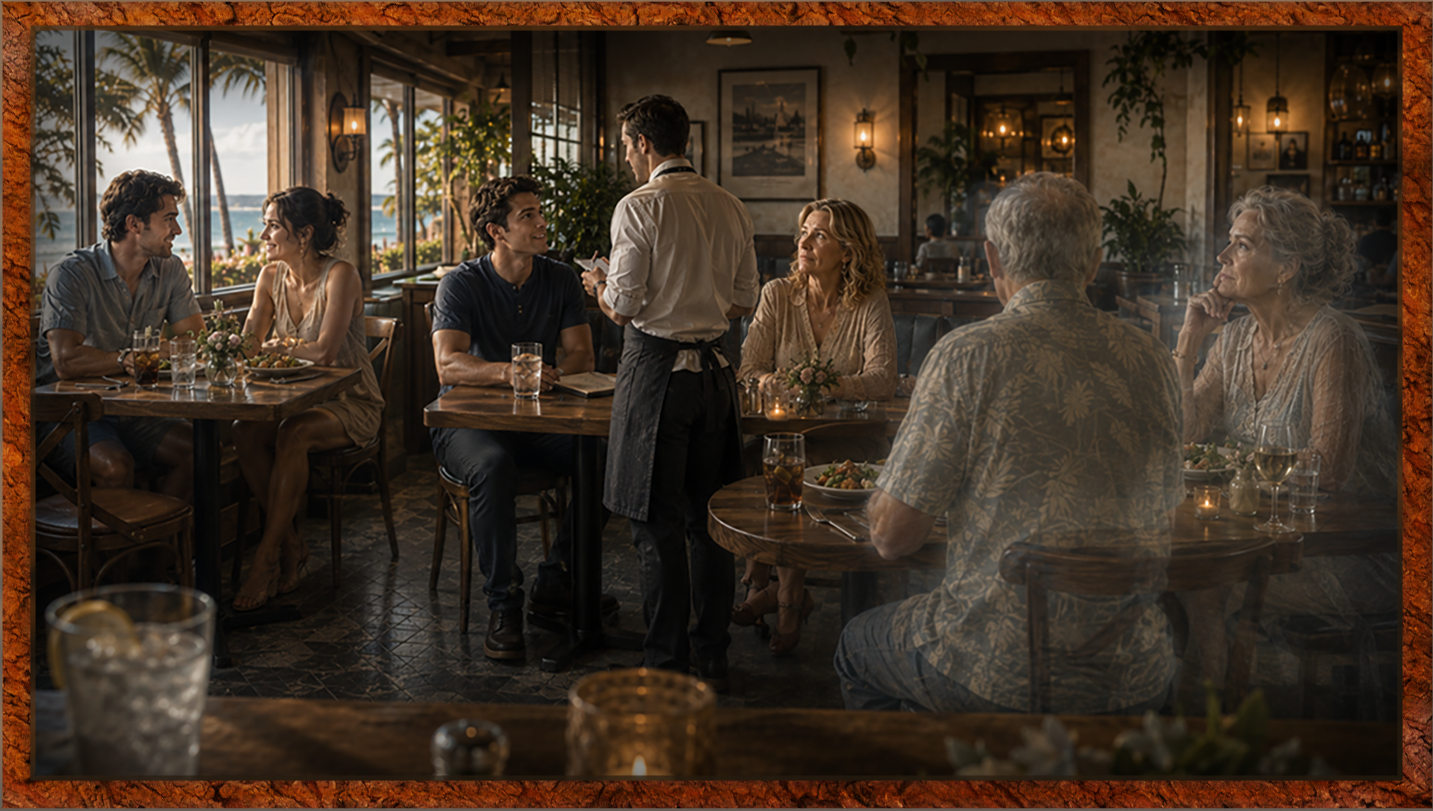
I wrote an article in 1993 that addressed the phenomenon of becoming invisible that I discovered during what I thought was a life-changing time in my life.
For clarity’s sake, the act of becoming invisible was related to an observation made back then whereby I was no longer being noticed as often when out and about in society. Truth be told, the experience was a bit off-putting. Salespeople were less attentive, waiters acted like I wasn’t there, and I could barely get a smile from the check-out person at the supermarket.
But now that I’ve gotten older, I realize that what I was experiencing thirty-odd years ago was a social phase of sorts. It wasn’t that I was becoming invisible; I was becoming irrelevant. Invisibility identified how I felt, but irrelevance was the verdict being handed out by society in general. It was driven by the simple act of aging and the scores of assumptions that followed the realization of where I was as part of that consumer age group. Back then, personal technology solutions were starting to become mainstream but were still more about status than substantive support.
My last two articles addressed how we’ve been losing our appreciation for the pursuit of knowledge, and how we need to make a concerted effort to find a more universal sense of purpose in the Age of AI. But before we address such complex and generational aspirations, we must first explore how we plan to address the diminishing value we hold for one another in this era where the overwhelming social, financial and political influences surrounding AI are changing the grand cosmic experience we call Life.
For the sake of better explaining myself, I thought I would create a word that could best describe the origins of this dilemma: Technapathy. It’s what happens when our fascination with technology quietly replaces the regard we once held for other people. The more we’re captivated by technology’s prowess, the less we’re able to recall the ingenuity of those people who once held our attention and awe, and they simply fade into the misty corridors of irrelevance.
Not to be confused with Technopathy[1], Technapathy relates to the manner in which we treat one another when in the presence of advanced technology that may render the value of a human being to where it no longer holds any interest or concern. Superfluous also comes to mind, but I needed for there to be a strong correlation between our love and admiration for technology while simultaneously developing a greater irreverence (and thus an unhealthy dose of irrelevance) for any of our organic counterparts.
“Any sufficiently advanced technology is indistinguishable from magic.” – Arthur C. Clarke’s Third Law
A variation on Clarke’s Third Law is perhaps a bit more on the nose: “Magic is just science that we don’t understand yet.”
So in deference to Mr. Clarke, does technapathy exist because we’re still astonished by the recent developments concerning artificial intelligence, or is this merely part of a much older issue wrapped in a shiny and awe-inspiring technological packaging?
In another recent article I wrote, I addressed the disparity of older Americans still having to be a part of the workforce. The following passage from that piece points to the encompassing nature of this article:
“Aging is the deadliest disease that exists on this planet. The symptoms are subtle yet unmistakable. Once we reach a certain age, we start to become invisible – from our families, our social circles, and even our government.”
Irrelevance is an awful feeling, regardless of whether you’re twenty-five or seventy-five. And in the same way that a 25-year-old person should be accorded every opportunity to prove themselves through the innovative ideas they bring to society, a 75-year-old person should be allowed every opportunity to be valued by the breadth and depth of the expertise, knowledge and judgement forged through years of common sense they brought to society.
Seneca once said:
“So it is: we are not given a short life but we make it short, and we are not ill-supplied but wasteful of it… Life is long if you know how to use it.”[2]
But in the 21st century, Seneca’s sage advice is turned on its ear as modern medicine provides us a greater life expectancy. Yet it’s our obsession with money and power that drives us to diminish the value we initially attributed to life. We may be living longer, but we’re doing so while finding it easier to dismiss the value of a human life by declaring it irrelevant.[3]
It’s very easy to lay the blame on AI for pushing us in the direction of devaluing a human life. It is no more guilty of human displacement or “FOBO”[4] as dull pencils would be the culprit for failing grades in schools. Technology aims to reflect who we are and not reshape who we wish to be. But in the same way that we must ensure that every learning tool is kept well within operational guidelines for excellence, we must take responsibility to protect the value of a human life; keeping it sacrosanct without weighing it down by the allure of corporate profits, business investments, or governmental undertakings.
“The true measure of any society can be found in how it treats its most vulnerable members.” – Mahatma Gandhi
Final Thoughts
“When a distinguished but elderly scientist states that something is possible, he is almost certainly right. When he states that something is impossible, he is very probably wrong.” – Arthur C. Clarke’s First Law
Irrelevance is a condition that enters every facet of a society, and that includes the natural world around us. Every living creature goes through a form of transformation, whether it be through a tangential process of evolution or a formalized human structure of thought, education or reason. And once each living creature (and yes, that includes us homo sapiens) becomes part of their ecology, relationships are formed from which others grow, shift, or change over time. “Keystone species”[5] within an ecological biodiversity have been proven to have immense effects within their environment when disturbed or removed.[6]
Like a keystone species in nature, every human generation contributes something to the whole upon which a society may depend on. When we decide that one group or another no longer matters, we lose knowledge, perspective, memory, and judgment. Every component of our environment in which we have an active hand at shaping will create changes in how we interact with one another as a multicultural species living within varying human societies. Yet the impact of how we either value, denigrate or make irrelevant a portion of our society will have an impact on how we’re able to pass on our knowledge and understanding of one another.
And if you’re thinking that such concerns will be made moot by AI, keep in mind one simple fact that I’ve expressed in prior articles: The training of artificial intelligence is rapidly reaching a stage where only another AI will be able to handle the training of faster and more complex neural networks. And although AI follows a probabilistic model by which to determine human patterns through the use of massive datasets, using deterministic methods by which to judge human decisions and behavior could be used to solidify the worst parts of our nature within the training of future AI systems.
AI will be driven by the actions of humans and the choices they make, but it’s humanity that will need to determine the value we possess as individuals and as a species. Regardless of what we will grow up to be or how advanced future neural networks may become, it’s the decisions we arrive at today that will influence the outcome of our survival and how irrelevant we may show ourselves to be to a future artificial intelligence.
Footnotes:
[1] The psychic ability to control, interface with, and manipulate electronic machinery, software, and hardware directly with the mind.
[2] From Seneca’s essay entitled “On the Shortness of Life” (De Brevitate Vitae)
[3] https://www.theguardian.com/commentisfree/2026/jul/20/ai-job-worries-human-skills-machines-cant-replace
[4] Fear of Becoming Obsolete
[5] A term coined by ecologist Robert Paine
[6] When a predatory starfish was removed from tidal pools, it was observed that the biodiversity of the pools decreased. The starfish ate mussels, and without the starfish the mussels took over and wiped out other species.
- The psychic ability to control, interface with, and manipulate electronic machinery, software, and hardware directly with the mind. ↩︎
- From Seneca’s essay entitled “On the Shortness of Life” (De Brevitate Vitae) ↩︎
- https://www.theguardian.com/commentisfree/2026/jul/20/ai-job-worries-human-skills-machines-cant-replace ↩︎
- Fear of Becoming Obsolete ↩︎
- A term coined by ecologist Robert Paine ↩︎
- When a predatory starfish was removed from tidal pools, it was observed that the biodiversity of the pools decreased. The starfish ate mussels, and without the starfish the mussels took over and wiped out other species. ↩︎
What you have to say will go a long way…