
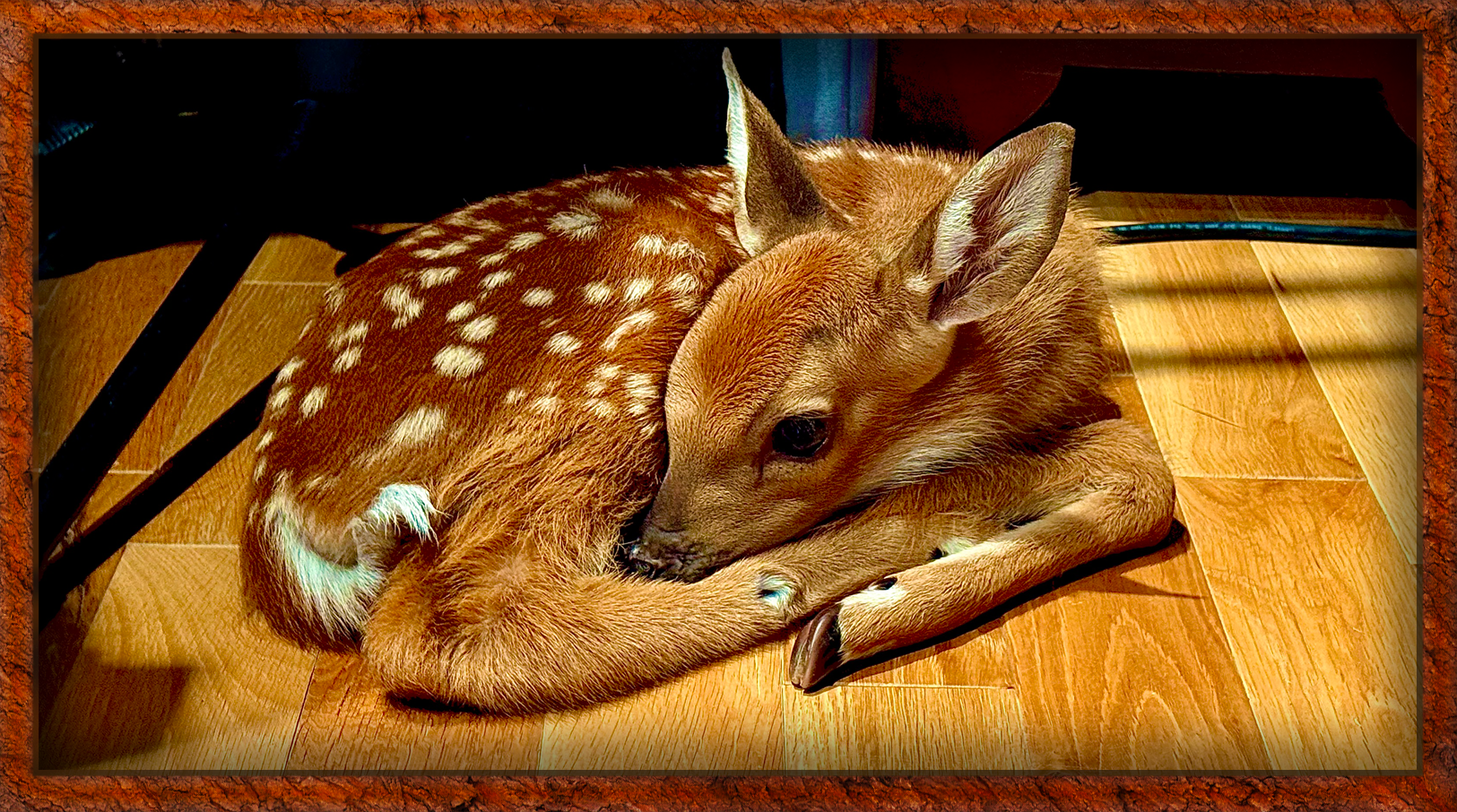
Last week, I wrote about a chance encounter I had with a fawn that I’m happy to say, had a happy ending. The article revolved around how empathy played a role in guiding my actions that eventually influenced the instinctual nature of the fawn itself. Yet as I was writing that story, I was compelled to explore how the world (and AI) would have interpreted my little encounter and what choices they would have prescribed.
The thoughts on empathy shared by philosophers, psychologists, behavioral scientists, etc. were no doubt eye opening. I will admit that overall, it felt somewhat partisan in nature as it relates to the human condition. But it wasn’t until I explored how life sciences address the logic of empathy that its dynamics began to come to light.
Peeling Back the Onion
The fawn I encountered reminded me that there are choices to be made when we experience something that challenges our perception of reality. In this case, feeling empathy for her was a foregone conclusion. Both CeCe and I have a great affinity for animals, especially those who are unable to fend for themselves. But when it comes to feeling empathy for another human being, the average person may find their brain used in several ways. Empathy is an overall autonomic process when our basic needs for survival are secure and we share a connection with someone who is generally worse off than we are.
Psychologists call this an intergroup empathy gap, and it’s comprised of two types of people:
- The ingroup which relates to those with whom we share a kinship or connection.
- The outgroup are those for whom we would feel empathy simply by virtue of their being human and in need of help.
The intergroup explains the dynamic for how these two groups interact and how empathy may become mired in a not-so-empathetic world of favoritism and social disparities that tend to be harsh against those for whom we feel little or no kinship.
By nature, we feel empathy for people we know (regardless of grouping) because it’s an instinctual reaction. Psychologists refer to the ingroup as System 1 and the outgroup as System 2. System 1 works on the basis of intuition and relies on interconnectedness (the us vs. them model), while System 2 is based on cognition and the deliberate use of logic, and relies on recognizing the need for empathy outside any specific group (the humans as part of humanity model.)
That’s a very basic model for our human empathy, but what about artificial intelligence? It uses a highly complex prediction model designed to understand the world by instinct. So AI would no doubt see empathy as a means to an end. But as AI advances and learns from the sum total of human history, how would it address the logical contradictions that arise from the potential relational disparities between humans?
Computer companies, universities and private think tanks have been exploring that in a process called the AI Alignment Theory. Think of it as the guardrails for ensuring that any AI model won’t be used or abused to exploit the worst parts of our humanity. But as AI continues to evolve, how well will those guardrails work in a future with more sophisticated neural networks?
In the same way that older humans are used to train younger humans (as a generalization), AI models will be used to train future enhanced versions of themselves. But a tipping point is bound to occur when artificial superintelligence (or ASI) comes into the picture. After all, how do you align to train a system that is smarter than humans? This very deep and complex subject containing various branches of thought has led to something called AI Superalignment. In a nutshell, superalignment looks at using specific models (like the reinforcement learning from human feedback model or RLHF currently in use) for training highly advanced systems to ensure that “superintelligent AI systems possess similar levels of robustness, interpretability, controllability and ethicality.”
Shall We Play a Game?
I know that a few of you have already allowed your head to slip into Sci-Fi mode. So let me help you align your visions with current theories. Given the exponential growth of the AI industry and its very hefty potential for generating never-before-seen wealth, the question of whether a future ASI will exist isn’t so much a matter of if as it’s a matter of when. So deciding who will be placed in the driver’s seat to oversee such a monumental training endeavor has to take center stage. Efforts have begun towards that end, but they currently revolve around the whole of the scientific and engineering spectrum, and rightfully so. However, such efforts cannot be considered holistic until they address the theoretical assumptions of how an ASI will see the world. For if such an entity were to become sentient, it bears addressing the possibility of it developing an awareness for self-survival. Given the persistent use of violence found in human history, it begs to question whether such highly evolved intuitive machines could ponder the nature of our humanity.
Final Thoughts
So what could AI learn from a fawn? Well, from a straightforward programmatic perspective, it could learn about the concept of choice as guided by the instinctual foundation embedded within empathy. Such a course of action addresses how we humans subliminally revisit our standards for morality, empathy and kindness on a daily basis. In the experience of meeting that innocent fawn, choices grew from a randomized group of feelings that ran the spectrum of a living entity’s need for physical as well as emotional survival.
All of us are part of a greater organic infrastructure from which everything and everyone (including AI) originated. That young fawn made a decision based on an established risk-versus-reward process. And regardless of what level of decision-making we may wish to grant, infer or suppose, it’s still a matter of fact. Deer are capable of making decisions primarily through learned behaviors, memory, and environmental assessments. And all of these decisions are based on learned conditions passed down by their parents.
Yet when I encountered that fawn, my choices added a unique dynamic to her reasoning that she had never experienced in her young life; the very same risk-versus-reward decisional tree that she would normally use, albeit without the myriad bits of information streaming through my head as part of that encounter. Regardless of the unusual circumstances presented, the fawn used its same thought process to assess its next move. In that encounter, the logic I chose cast the deciding vote and fed a series of actions on my part that altered the fawn’s risk-versus-reward process that caused her to aim at a new choice. That is the power of empathy; that is the fuel of choice.
So the true question here is what can AI learn from such an interspecies event. And in order to address that correctly, we need to take aim at our current relationship with nature.
In the case of the fawn and its herd, the need for survival adapted to include the encroachment of humanity. Whereas deer have been foraging and surviving in pretty much the same way for countless generations, humanity’s role in nature took a sharp turn with the development of agriculture. Over many thousands of years, hunting surreptitiously slipped from a regional necessity to a national hobby and a sport, all encased within vast collections of communities that drove heard animals like the deer to adopt different foraging patterns while developing a focused instinct for humans as an apex predator.
That may be a highly simplistic explanation, but the point here is history; the narratives that outline how both deer and humans have evolved from their instinctual foundation to where they are today. And more importantly, how their respective instincts still carry a connective thread that can be found under the right emotional and instinctual conditions.
For deer and other foraging animals, the need for territoriality has maintained its roots in the availability for food, water, and shelter. For humans, the manner in which we foraged for those very same needs changed drastically when we went from being nomadic hunter-gatherers to establishing permanent settlements. This would no doubt change how foraging animals managed their territoriality and dealt with the permanent presence of humans and how that affected the herd’s numbers and their ability to find sustenance. Since the beginning, choices made by the developing brains of humans caused variations in how the deer (and other foraging animals) made choices.
For the sake of our future, we need to teach AI to recognize and understand this long and enduring relationship, and the delicate balance it brings to the survival of our respective species. As stewards of this planet, it’s our responsibility to realign our path towards survival by switching from conquest to collaboration; from wanton destruction to willing cooperation. Nature gave us a higher intellect to help create the wonders of science and technology of which AI is a great part. Our biggest challenges lie in our ability to develop a greater sense of empathy, kindness and collaboration for the survival of the human herd. If that little fawn could find it within herself to exhibit a straightforward example of a rational decision based on a sensible assessment of its own instincts, we should be able to guide AI to understand and implement those wonders in nature still waiting to be discovered for the sake of our collaborative future with AI.
What you have to say will go a long way…