
Empathy has long been considered one of the defining attributes of a moral or ethical person. When we speak of morality, empathy is certainly to be found, though it will be in an almost endless loop in terms of how much is needed. There are those who feel that empathy is a weakness. That it emotionally restricts us to care only for those people with whom we sense a kind of community or kinship; that sensing the suffering of others diminishes our ability to be a positive force for good for anyone, regardless of affiliation.
It’s fascinating to read some of the opinions voiced by philosophers, psychologists, behavioral scientists, etc. Yet I can no more point you in the direction of someone who may be more correct than others than I could say with absolute certainty, “yeah; that person’s got their act together.” But what I can indicate to you is where you’ll find a wonderful laboratory on the mechanics of empathy: Nature.
Since there exists so much negativity these days concerning the act of being empathetic, I thought I’d share an event that happened to me last week that may help to clear the air. All I ask is that you take a moment to read this story before you start to formulate an argument regarding empathy vs. instinct.
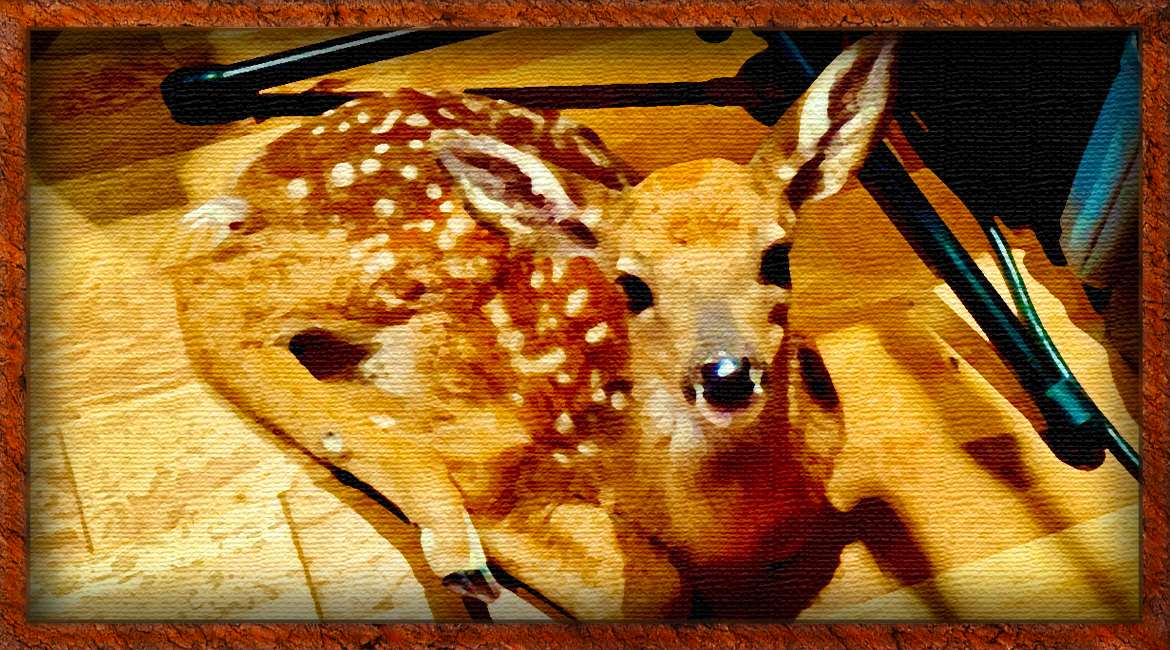
As I was mowing, I came upon a fawn laying down in the grass. I know that their mother (a doe) will often leave their young hidden in tall grasses (and often for long periods of time) while they forage for food. But this little one wasn’t in tall grasses; she was lying on the lawn. And she wasn’t in some hidden part of the property; she was out in the open where she could be spotted easily.
I was wearing gloves at the time, so I opted to check that the fawn wasn’t injured, bleeding or sick. She was fine. But her breathing was shallow and she did little to react to my presence. Nonetheless, I decided to let nature play out this scenario. I just made it a point to check on her from a distance to see if there was any change, or if I saw any deer or other animal coming out of the woods at the edge of the property.
The few of you who read my articles will recall a story I entitled Bambi, all about a precocious fawn that suffered a horrible accident while running away from some perceived danger. That incident was certainly on my mind, and I didn’t want to see it repeated.
By 7pm, I saw that there had been no change in the fawn’s location or even her position on the lawn. Nor had I seen any deer grazing in the back fields. So I made a decision to bring the fawn into the house for the night, and I would then contact a sanctuary in the morning that could take her in. Using a large plastic container we used to store lavender, I placed a clean blanket inside and then went to retrieve the fawn. When I picked her up, she didn’t move or cry out. She stayed motionless as I was carrying her to the house and I wondered if she would survive the night.
I placed her in the living room and went to my office to look up what would be an appropriate food for a small fawn. Several sites noted that I could try giving her a Spring leaf lettuce or a small piece of apple. She ignored the lettuce but took a passing interest in the apple before she stopped herself and laid her head back down. OK; no food. I went about my tasks for the remainder of the evening and stopped by every so often to see how she was doing. Each time I came by, she was in the same position as when I found her outside. Before I went to bed, I placed a small webcam on the living room floor so I could check in on her, just in case.
At around 2am, I was awakened by a noise and quickly grabbed my phone so I could check the camera feed. The fawn had gotten out of the container. I went downstairs and found her with her legs splayed out in front and behind her. She wasn’t in distress; she almost looked puzzled. We have hardwood floors, so it was clear that there was no footing to be had for her small hooves and long, slender legs. I went and put on a pair of gloves, then came back and took the blanket out of the box and placed it on the floor. I then picked her up and stood her on it. She held herself upright for a moment until she took one step and then down, she went.
But here was the first change.
She turned and looked at me. When I moved my hands, her head remained in place. Yet when I moved my head over to the side, she turned and kept her gaze on me. And although her ears were still droopy, she raised one in my direction when I spoke to her. I stroked her gently on the head then decided to let her be and went back to bed.
When I awoke later in the morning and went downstairs, I saw that she was no longer in the living room; she was in my office sitting by my chair. When she saw me come around the corner, her head perked up and this time, both her ears were trained on me. When I spoke to her, she bleated softly and just once. I figured that she might be hungry, so I tried the Spring leaf lettuce and another small piece of apple. Her reactions were the same as before.
After breakfast, I went to my desk and researched a proper sanctuary for the fawn. The entire time I sat there, she stayed right next to me. When she heard me speaking on the phone, she would bleat once or twice, then just stare at me. This went on for a few hours until I finally found her a lovely home. I prepared the container as I had done before, placed her in it, and then took her out to the car. As I began driving, she bleated a few times, no doubt because the car’s movement was new to her. I turned the radio on and set it to a local classical music station, and she was asleep within minutes.
The Heart of the Matter
“Cute story, Frank. But what does this have to do with empathy?” Well, a lot. Animals are sensorial by nature, communicating through a variety of senses. We humans have many of the same perceptions, though we are more prone to being fooled than are most animals when it comes to trusting our senses.
It’s very important to clarify that I am not equating an animal’s sensorial framework to be the basis for emotions. We humans have a brain that allows us to reason and rationalize our environment, our perceptions and our actions. Whereas animals have heightened senses, we generalize our sensorial input and use our purported higher intellectual and processing brain power to make assessments, conclusions and take actions.
In the case of the fawn I encountered, she did follow her instincts in attempting to bond with me because of a lack of a nurturing parent. The possibility existed that something may have happened to her mother, so the fawn opted to bypass her natural instinct to hide in favor of seeking shelter, food and protection from another being. That’s because instincts are genetic predispositions and not a set of unbreakable rules.
In most cases, a fawn will lay low and follow its instincts for about 24 hours. Beyond that, the fawn may venture out from its protected area to find its mother, bleating loudly as it wanders. Yet when I found her, this fawn was not exhibiting those typical behaviors; she remained quiet. My feelings for this creature notwithstanding, she chose to seek me out within a few hours of our encounter. By the time morning came, she had already sought out my scent and decided to wait for me in a place where my pheromones were strongest. In the midst of her instinctual process, she made a choice. And although she was undoubtedly hungry or thirsty, she did little to act on those physical signals, choosing instead to remain quietly by my side, favoring security and companionship.
This little fawn reminded me of a very important lesson: That we all have a choice to make when confronted with a situation that challenges our status quo. There is a mountain of information out there that addresses the psychology of empathy; dissertations about the mechanics of how this sensibility works within the framework of society. And that, my dear readers, is the problem. For in this world of ones and zeros, of formulae and algorithms, we’ve chosen to analyze every aspect of what resides within us. And although there is nothing wrong with that, it shouldn’t be a matter of replacing what we discover for what we feel. Our knowledge of the world should not replace or compete with our natural tendencies but rather celebrate their wonders.
Final Thoughts
In the experience of meeting this innocent fawn, the choice for empathy was clear because neither of us wanted anything from the other beyond an opportunity for one to feel safe and the other to feel good in having helped another in need. For those who get lost in deciphering the mechanics of the natural world, there was no mystery here. It was nothing more than a simple act of caring encountering an innocent yet frightful moment for survival. Ideologies aiming to dissect that moment would only encounter a reflection of their fundamental core: A simple act of caring wrapped in a degree of trust.
I can only imagine how this story may have unfolded had I opted to turn over my initial discovery to an AI agent. It would have recognized the maternal instincts of both the fawn and its mother and assessed that the best course of action would be to leave the fawn alone and let nature play out. But instincts are predisposed to a variety of options, and a machine based on prediction models would assign weights to every option and decide in favor of a purely instinctual reaction.
But that wasn’t the case of that experience at all.
Empathy is not a weakness. It’s an emotion designed to intercede between our reactive mind and our innate ability to care. It happens at the speed of thought when our mind begins to recognize vulnerability in another living thing and wishes to make a choice. Empathy steps in to guide us toward what we perceive as the most compassionate response.
In the case of that little fawn, she needed safety, and I needed to interject a small measure of goodness in my tiny corner of the world. Nature offered us both what we needed most, and that was a valuable lesson that shouldn’t be lost in this, our overly digitized world.


What you have to say will go a long way…