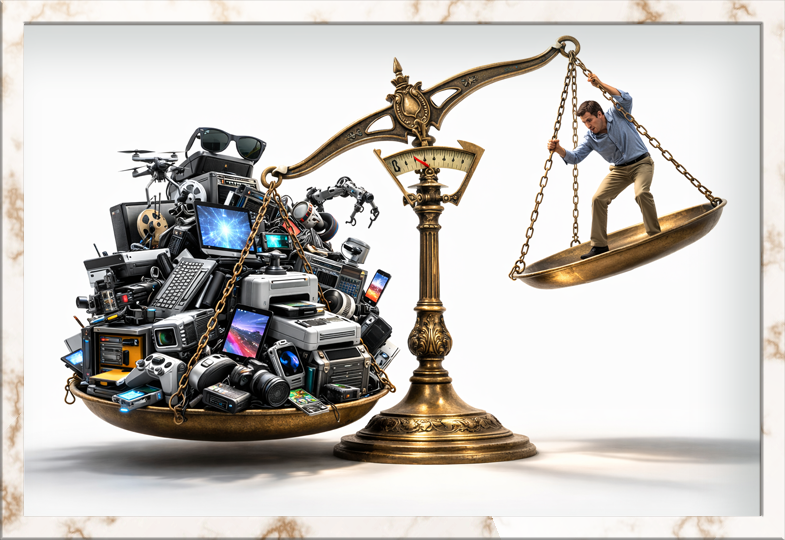
Recently, the latest version of the Ray-Ban Meta smart glasses have been making the rounds in the news and various online talk shows. But this commentary won’t be addressing their technical capabilities so much as their capacity for inspiring opportunistic behavior.
About twenty-five years ago I was at a technology trade show in Las Vegas. Among the various vendors in attendance was a major hardware manufacturer that was showcasing a portable device that was to be the next evolutionary step in automating office-based tasks. I won’t mention the product nor the company, mainly because they’re immaterial; what they were offering, was. After the representative finished his presentation, I walked up to him and asked a simple question in private: how had his company addressed the manner in which their product could be used to circumvent copyright laws?
After a momentary blank stare, he adeptly delivered a company monologue about thorough research and market studies. Yet when I went back the following day, I noticed that the particular item demonstrated the day before was missing. Interestingly enough, a large-scale variation of that concern I had back then was recently deemed legal under the Fair Use Act[1] when addressing the use of published books to train AI models without the express permission of the authors.[2]
At the risk of turning that experience into a cliché, such scenarios have opened up a Pandora’s box that is more likely to resemble a hornet’s nest. And that’s because technology firms continue to create either processes or equipment that provide the means by which to either encourage – or, to bastardize a segment of Abraham Lincoln’s famous quote – tempt the lesser nature of our angels. To paraphrase a quote from a dear friend of mine:
Just because they can doesn’t mean they should.
Having followed technological trends since the late 1970s, I’ve always been intrigued when products became available that could bring about a way to enhance certain market sectors. As a teacher back then, I saw the potentiality that personal computers could have on education and began using them to enhance key learning objectives in my classroom.
But in the same manner that there are two sides to every coin, so there exists a way to use technology for creative and criminal endeavors. Proponents of gun ownership are always quick to point out that guns don’t kill; people do. So the same can be said about technology; computers don’t commit crimes; people do. But if we take this facile argument and apply it to today’s technological landscape where computers are being designed to reason or intuit, aren’t we bequeathing – or at the very least, sharing – that responsibility?
I’m not so much blaming technology companies for any wrong-doing; merely pointing out their woeful lack of social responsibility. They have brought to life some of the most intrusive and potentially destructive products in human history, from ubiquitous biometric surveillance to AI-powered analytics; from dual use delivery systems to autonomous AI-enhanced drones capable of delivering lethality for short or long-range payloads. When government entities (purportedly representing the will of its people or constituents) decide to engage in the usage of these technological assets, that measure of social responsibility falls on them to ensure that the will and safety and survival of its people and allies are respected, protected and maintained.
Final Thoughts
With more invasive technologies on the rise, there needs to be an equal and concerted effort on the part of everyone to take the ramifications of their actions (or inactions) to heart. When we choose to acquire any system, mechanism, vehicle or technology, we take on the mantle of responsibility for the safety, security and welfare of those around us. It reminds me of the Golden Rule that we grew up with, based on a quote from Luke found in the Bible:
Do unto others as you would have them do unto you.
In the 1960s, that quote was given a quirky twist:
Whoever has the gold makes the rules.
In general within a society, government entities establish laws, mandates or regulations to ensure that the rights of its citizenry are protected and secured. But that cannot be seen (or excused) as an impenetrable barrier to protect everyone. That responsibility is neither a regulatory nor a regional issue; it’s a global mandate. Because if we decide to either relax, generalize or ignore the logic that only people bear the responsibility for committing crimes or killing people, then we should be wary of the people we choose to be in positions of authority (whether within social, manufacturing or political circles) who aim to operate solely on one set of policies, rules or principles that aim to concern themselves with the few or the one.
Science and education merely provide the foundation upon which a more enlightened society may be established. But the society is made of people and foundations are built by people. So if we see ourselves as being a part of the human equation that pushes every button, takes every action and establishes every governmental agency, then the results of whatever we may enjoy, put-up with or suffer will fall squarely on our shoulders.
[1] (in US copyright law) the doctrine that brief excerpts of copyright material may, under certain circumstances, be quoted verbatim for purposes such as criticism, news reporting, teaching, and research, without the need for permission from or payment to the copyright holder.
[2] https://www.nbcnews.com/tech/tech-news/federal-judge-rules-copyrighted-books-are-fair-use-ai-training-rcna214766
Leave a Reply