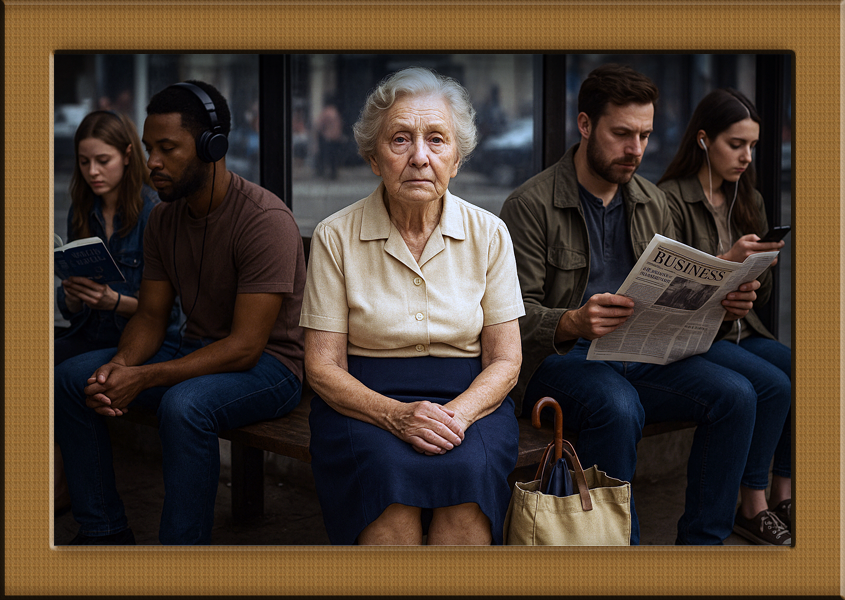
I Don’t Have Time

Not too long ago, I was at the Deli counter in my local supermarket. I was focused on my list of things to get when I walked up to the counter and grabbed one of the numbered tickets used to secure a place in line.

As I glanced up, I noticed the person working behind the counter, as I had not seen her before. She was a very personable 70-something lady who seemed quite at home using all the necessary skills for that job. But as I looked at some of the other folks working with her, I noticed that they were easily half her age. Nonetheless, she kept up the pace and never lost that smile; her slender hands moving with grace as she went from the coolers to the slicer; from the register to the counter. Her sense of purpose held a quiet dignity and understated tenacity that is emblematic of many people in her age group.

A customer walked up to the counter who obviously knew her.

“Hey, Miss Taylor, it’s good to see you! What are you doing here? I thought you had retired from teaching and were going to take it easy!”

The person said this in a very endearing manner. She looked up and instantly recognized the gentleman.

“Howdy Bill! Good to see you, too! Oh yes, I did retire but I don’t have time to spare these days. I have to keep going!”

That little innocuous conversation really stuck with me. I’ve been so tied up with what has been going on in my life that I had not paid attention to the number of people who are still working past the proverbial age of retirement – euphemistically referred to as The Golden Years.

According to the 2022 statistics from the National Council on Aging,1 approximately 20% of the population of the United States (US) over 65 (about 11.3 million) were still part of the workforce. The total number of people over 65 in the US was 57.8 million, meaning that approximately 20% of the adult population over 65 was still working. That is almost double the amount of people in that same age bracket who worked back in the mid-1980’s. The statistics are quick to point out that this is due to people “aging better and living longer”; living independently and being overall healthier than their predecessors. These rosy statistics also stated that on average in 2022, a person aged 65 could expect to live an additional 18.9 years.2

Yet Ms. Taylor at my local grocery store didn’t believe that she had “time to spare.” If our older citizens are living longer, healthier and independent lives, why would they choose to spend these golden years working?

Because most of them don’t have a choice.

In 2022, it’s interesting to note that of those 11.3 million people over 65 who were still part of the workforce, 10.3 million lived below the poverty line. Out of those, 14.1% (or 1.45 million) met the definition for living ‘under the poverty line’ per the Supplemental Poverty Measure from the U.S. Census Bureau.3

But the necessity for having to work as a senior citizen while being fitted with that mantle of poverty creates other unintended issues that many tend to overlook or ignore. There’s the matter of social isolation – not just from the stigma of being poor but for being old. And in the majority of cases, 65% of these folks live alone, creating a dynamic of loneliness and seclusion that deeply impacts their emotional well-being. In people age 60 and above, these changes coincide with recent studies showing how biomolecular shifts happen at key periods during our lifeline.4

These shifts are made more profound by the emotional trauma of silent social disparagement or the personal weight of poverty. You see these signs manifested through changes in posture or pace; the vacant expression in eyes once filled with life and light. These physiological changes bring about feelings of anxiety, humiliation and apathy – all which significantly exacerbate their cognitive decline impacting memory, daily functions and motivation, all which increase the likelihood for dementia. And despite what you may believe, there is a very real stigma to being elderly and poor. Poverty becomes very much like a lava flow; it moves slowly and often imperceptibly, but it still destroys everything in its path and there isn’t much that you can do to stop it.

Or is there?

Poverty doesn’t just equate to not being able to go to the movies, or eat at a restaurant, or purchase that (fill in the blank here) thing that you’ve just gotta have. Poverty also doesn’t mean that you don’t have a penny to your name. It means you no longer have the financial resources to take care of basic, everyday needs such as food, utilities, medical care or medications, or pay for your rent or mortgage. In this world of social media connections, being poor means that you may no longer be able to maintain a social presence, further alienating people from a world that was once a vibrant part of their lives.

I’m not about to go into the issues of social services, government subsidies, or the social contract for social security. These subjects instantly raise everyone’s ire about government malfeasance, party politics, the gross ineptitude of politicians, etc. If you wish to have those conversations, well, that’s what family gatherings during the holidays are all about. At least, that’s the case in the 21st Century. I’ll just reiterate something that I’ve shared before that was said to me by my grandfather: When you point your finger at someone, keep in mind that there are three fingers pointing back at you.

Wow; did the Grinch hire you to support his ‘Retribution Tour’ for eradicating the Christmas Spirit?

No; I think society in general does its fair share of taking care of that. We’ve ostracized empathy to the point where the only people we care for are those within certain small sociopolitical circles. Yet the one group that seems to fall out of favor even under those shameful classifications are old people; the ones we label as ‘senior citizens’ but provide no indication of respecting neither their social seniority nor their rights as a citizen. We place them in neat little descriptive boxes bearing all manner of labels and eventually ship them off to residences that are nothing more than hospices with guilt-cancelling names such as Serenity Village, Harmony Estates, Evergreen Haven, or Radiant Life. But, no – this article wasn’t written to kill the Christmas spirit, to make you feel guilty or shame you into calling your grandmother. It was written to make you aware.

Aging is the deadliest disease that exists on this planet. The symptoms are subtle yet unmistakable. Once we reach a certain age, we start to become invisible – from our families, our social circles, and even our government. Eventually, this disease begins to dull our ability to demonstrate cognitive functions; it reduces our experiential knowledge and our ability to be either prescient or purposeful. In later stages, we lose our voice; our ability to express concern, desire or insight. In time, this disease robs us of our will, our sense of humor, and even the desire to live. And it’s terminal; once you begin to develop the signs of aging, the spiral is slow, methodical, quite democratic and incredibly efficient.

Final Thoughts

So as you’re running around buying last-minute gifts for the people whom you love, care for, or even loathe but there’s that game you have to play to get ahead, I’d like for you to think of what you can get for the old people in your life. I’ll give you a few helpful hints: They don’t want –

  • Aftershave
  • Board games
  • Boxes of candy
  • Candles
  • CDs of their favorite artists
  • Gag gifts
  • Gift cards
  • Hats
  • Shawls
  • Slippers
  • Tablets
  • Talcum powder

What they do want is time. They would love to spend time having a meal where they can be part of your crazy, loud and beautifully dysfunctional family life for an evening. They would greatly appreciate a surprise visit. It wouldn’t require purchasing anything; just bunches of warm hugs, smiles, anecdotes of what’s been happening at home or in your life – complete with a few pictures or videos right from your phone. They would really enjoy being taken out for a spa treatment or a meal at one of the restaurants they used to frequent, or even a visit to a park, museum, or a chance to sit by the beach, a lake or a pond.

In other words, for this Christmas, give the senior citizens in your life a break. A break from the monotony of a stagnant life; a break from the soul-crushing sadness that comes from being lonely in the middle of a crowd; a break from being forced to walk among the ghosts of past successes, loves, and accomplishments. Take the time to sit with them and ask for their advice; for their insights and opinions. Because they spent a lifetime gathering knowledge, experience, wisdom and enlightenment from the myriad imperceptible moments in nature and in society that changed their worldview forever.

And the day after Christmas, give them a promise. Give them the one gift they’ll treasure always – to repeat Christmas every month of the year as a family member or friend who can be seen, heard and enjoyed for being who and what they are. These steadfast souls are all around you; in your family, in your circle of friends, and in your neighborhood. They may be nameless people in a crowd or like Ms. Taylor, someone who hands you that order from the deli counter, rings up your groceries or greets you as you walk into a store. Kindness is more than just a social grace; it’s a way to lessen the unspoken burdens we all accumulate through life. And although it’s true that we can’t cheat death, we can still eliminate its sting by providing the gift of dignity.


  1. https://www.ncoa.org/article/get-the-facts-on-older-americans/ ↩︎
  2. National Center for Health Statistics. Mortality in the United States, 2023. Dec 2024. https://www.cdc.gov/nchs/products/databriefs/db521.htm ↩︎
  3. U.S. Census. Poverty in the United States: 2022. https://www.census.gov/library/publications/2023/demo/p60-280.html ↩︎
  4. https://med.stanford.edu/news/all-news/2024/08/massive-biomolecular-shifts-occur-in-our-40s-and-60s–stanford-m.html#:~:text=The%20study%20also%20found%20that:%20*%20The,health%2C%20especially%20in%20their%2040s%20and%2060s. ↩︎

10 responses to “I Don’t Have Time”

  1. Great as usual Frank. In my youth I learned to make time for things and people that matter. Time is precious and I hate to waste it. But you can believe if I’m with you, then you know it’s our time. It is not only time shared but the time you set aside to share yourself. That gift you made time to create for your host of Dr.’s and Nurses. The invisible work forces The Amazon person for your deliveries, the U.S. Postal Service, UPS , FedEX drivers or your trash collector. You can best appreciate them only when you realize the impact they have on you and your life. The key is the Thought you put into the creation, designing or even buying something for someone or group. This works for me and my family and quite a few of my friends as well.

    1. Bernie, thank you so much for your kind note. One of the many things I’ve always admired about you is how committed you are to the moment. I can attest from personal experience that you make every moment feel special, because you pledge yourself to spending your time with that person. And that’s such a simple yet powerful attribute to have in life. It’s transformative in ways that sometimes we may not even see; and that’s ok. Because what matters is the positive and lasting effect we’ve share with another human being. The action itself is immaterial; what matters are the consequences that the action brings about.

      Like you, I’ve always taken the time to be mindful of my focus with others. First and foremost, because it shows that we respect the time or attention that another person is giving us. And it’s often a simple hello, a smile or a simple commentary that makes a difference. Because we have shared our time, and through our actions or words have shown another human being that in that moment, they were important to us; we saw them. Thanks for taking the time to write in, Bernie – always a pleasure!

  2. You mentioned how Materialism holds no sway over the heart or the soul. What l notice with friends & acquaintances is that their obsession is with money. They have plenty of it but fear that it is never enough, that it may be mismanaged, an insecure investment; it is a fixation.

    They truly are good, caring people to a certain degree but money dominates their way of life. We can observe with politicians (as one example) that possessions like: Large house(s), cars, a private plane…increase as their position in the government is secured.

    Actors, actresses, sports figures are paid exorbitant fees to keep us entertained, distracted – but from what? And we keep informing ourselves of the inept operations, poor decisions, corruption, ineffective leadership, strategic errors of the administration; why waste all that time?

    Your blog is about ‘l don’t have time’. l find that many people must be kept busy so they do not have time to analyze their lives, or to look within. We are advised to multitask, to keep our mind occupied at all times with menial things.

    Then we have the TV, smart phones, computers – all distractions. It is a vicious circle that the government promotes to keep us occupied and ignorant of the mismanagement of our country & they are succeeding. We have become comfortable, lazy to a degree, complacent, so why should we rebel? We accept the incompetence of the ruling parties as long as it does not affect our self-satisfied lives.

    1. Nina, thank you for commenting again; I’m glad the article has given you pause to think about the subject. You do open up a point that lies at the foundation of Ms. Taylor’s story – that being the propensity for some folks to get caught up in a wave of commercialism and materialism that places them, from a financial standpoint, on a gerbil wheel for spending, hoarding and flaunting money and possessions. IMHO, I’ve found that this tends to happen when people cannot recognize anything else in life that is more precious than money.

      That issue has been espoused many, many times, and yet we still continue to grovel for money, cheat for money, steal and sometimes even murder for money. I was struck when Michael Jackson released his double album HIStory: Past, Present and Future, Book 1 in 1995, because it contained a very revealing song entitled, Money. Although never released as a single, it was a scathing indictment against those who would exploit people for money. Beyond Michael’s personal issues and troubled life, he had created a musical manifesto of sorts that points out the fundamental issue about money: It’s imbued with a power that allows us to be coerced, mismanaged, abused, bought, sold, traded, and destroyed, and yet we haven’t found a way to rid ourselves of its grasp.

      Without money, how would the world function? Well, it would require a deeply fundamental change to our way of thinking that I’m afraid would be impossible. So we need to learn how to lessen its effect on us, and that could also very well be nearly impossible. We have developed a deeply-seated belief that money is the ultimate fast track to everything we wish to have. Well, everything we wish to have that we’re told we should have: Power, possessions and people. And thanks to the reckless billionaires who are currently jockeying themselves to run the world, the children of today are being taught one very simple and catastrophic lesson: When you have money, you can literally rule the world and do anything to anyone at any time. It’s the ultimate food for thought in a world starving for meaning and enlightenment.

      Thanks again for writing, Nina. Keep those thoughts coming and most importantly, keep asking questions.

  3. Thank you, for pointing out the obvious, the obvious we all tend to forget.

    Keep writing, and keep reminding us all how amazing this life truly is.

    Arpi

    1. Arpi – thank you for you insights. That has been my aim and part of my promise, so you’ll find other articles in the blog along that vein. Here’s to spreading the news about the wonders to be found in the obvious. Take care!

  4. Frank, for those of us who are entering, or already living in, these so-called golden years, what you’re pointing to feels very familiar. It isn’t just about getting older; it’s about that moment when you realize the world has started to look past you instead of at you. You captured that shift so clearly. People like Ms. Taylor aren’t clinging to work for identity, they’re holding onto agency in a system that’s quietly decided they’re done.

    What kept echoing for me is how layered the losses are. It’s not only money or security, it’s dignity, choice, and being met with basic empathy. That feeling of being present but somehow translucent… alive, yet treated like something already filed away, has happened to all of us over 60.
    And you’re right, this invisibility isn’t inevitable. It doesn’t just “happen” with age. It’s chosen. It’s reinforced with soft language and comforting labels, with institutions that sound kind until you look closely, with statistics that blur the human cost. Living longer without real support isn’t a gift. It’s just more time inside neglect. You see it in posture, in speech, in humor that fades. Not because of time, but because of being dismissed over and over again.

    What I value most here is how you keep this grounded in responsibility and presence, not noise. You remind us that what people want most at this stage can’t be outsourced or managed away. They want connection. To still belong. To be part of the living fabric of family and community, not handled, not stored, not pitied.

    There is beauty in refusing to look away, in choosing presence over convenience, relationship over avoidance. Your message reminds us that care is not an abstract virtue; it is an act, repeated daily, in how we notice, how we listen, how we stay. In naming what is broken, you also reveal what is still possible, and that, perhaps, is the most generous offering of all.

    Maria

    1. Maria – as always, thank you so much for your insights. This piece was difficult for me to write, as like you I am steeped in this age group. What’s sobering for me is that I began seeing the social changes when I turned 40; I even wrote an article about it back then entitled, On Becoming Invisible, where I wrote about the “super power” of invisibility that became apparent at that age.

      Once again, I have to thank some incredibly insightful and unforgettable people who taught me so much in my early life. People like my grandfather and older uncles who demonstrated the glory of aging through their wit, intelligence, fierce determination, and a quiet yet proud acceptance of aging. I recall bombarding my granddad with endless questions about everything, and he was always happy to answer every single one. My uncle who was a computer scientist was equally pummeled with myriad questions. Not only did he answer them with enthusiasm, but with appreciation and glee. In both instances, these men demonstrated to me the power and wisdom that resides in aging, and anyone who allows such gifts to go undiscovered is beyond foolish – it’s irresponsible.

      I’m glad that the issue of feelings resonated with you. There are myriad feelings and emotions that flow through us during the course of our lives. These change as we grow older; like the seasons, they each bring with them the awareness of growth, movement and change. But we shouldn’t interpret winter as an indication of death. As we age, I like to believe that our final stage in life is Spring. It’s a time to rediscover the beauty of renewal and the ensuring blessings of continuity. Those who have lived a long and fruitful life possess within them the seeds for that renewal. It’s up to us to be mindful to harvest them and ensure that they’re planted in the fertile minds of youth. Not as a means to replace, but to nourish the possibilities for the future.

      My approach to the subject of aging is nothing new. From musicians to artists to philosophers to writers – they’ve all tackled the conundrum of aging. It is second only to our preoccupation with death; the eventual and unmistakable coda to the symphony of life. My hope is that people still early in that journey will take the time to discover the endless font of knowledge and experiential wisdom that is within their reach. That they’ll turn back to rediscover the people whom they’ve most probably already begun to turn their backs on. That loss is a consequence of youthful foolishness that I hope I can help them avoid. And for those who are already in this final stage of aging, I want this article to let them know that they’re important; they are loved and they are without a doubt their community’s greatest and most endearing natural resource.

      Thanks again for sharing your thoughts, Maria!

  5. Querido Frank, this is a crucial topic, especially since we are living longer and account for the 11.3 million elderly people over 65 in the USA, as stated in those statistics.

    The subject of aging is difficult to analyze and comment on when one finds themselves in this category. Keeping active is essential, physically and mentally, especially with activities and hobbies that are enjoyable and rewarding. If one scrutinizes the life cycle then they come to realize that as an infant one is not cognizant nor understands their surroundings or the purpose of their life. They recognize a few people who are there to attend to their needs & who they can depend upon.

    As people age they lose perspective of their environment; they do not distinguish their family or friends. They decline, deteriorate and have special needs the same as an infant. It is the inevitable cycle of life. We are born, doted on, live fully, digress, are cared for then die. The pendulum represents the relentless rhythmic flow and passage of time. Our time on this earth is measured, although unfortunately we are unaware of the span or longevity.

    It isn’t always a necessity when one finds elderly people working at a menial job. Many times they want to keep busy and like that they are needed, rewarded even if the compensation is minimal. For those who need the money, it is unfortunate. Yes, the government should provide them with compensation (instead of many younger people and non-citizens who take advantage and are not properly screened.)

    In some countries seniors are lauded, cared for with respect & their opinions esteemed. Materialism prioritizes material gain and acquisition for happiness. This mentality has no use for idealism which emphasizes mind/spirit, focuses on personal gratification and devalues non-material pursuits like culture or spirituality.

    Are we going to change the mentality of a country with people who worship materialism? As you state if one can at least be given the gift of dignity, then that is ‘one step forward’.

    Excellent blog and food for thought.

    1. Nina, thanks again for taking the time to send in your thoughts. You brought up an interesting point that it’s hard to look into the subject when you happen to be part of the age demographic. But that brings up the matter of how we feel. There’s an aphorism that says, “age is mind over matter; if you don’t mind, then it doesn’t matter.” Despite the humorous intent, there’s a good deal of insight in it. I recall a gentleman with whom I worked years ago. He would constantly caution people about what to expect when they got to be “his age”. He wore a pork pie hat and reading glasses that fell halfway down the bridge of his nose. He walked with a somewhat slow gait and would always talk about needing a rest, even though he always appeared to be in good shape. One day, I asked him about what I should expect when I hit his age. But his answer stopped me in my tracks – he was nine years younger than me!

      Our perspective of life changes from one decade to the next. And from a sociological standpoint, it all depends on where we happen to be standing and the direction in which we choose to look. As we get older, I like to think that we start to see things a bit more clearly. The past teaches us that there is a future, while the present teaches us that there’s wisdom in the past. That helps us to see that the future can teach us that the past is a present because it provides the introspective wisdom of experience.

      But poverty skews these perspectives. It diminishes our ability to move freely in a competitive world. It signals things that we may not necessarily represent, but the stigma from years of social entrapment may block out any desires that light up our passions. Yes, some folks from older generations do enjoy working; it provides a sense of purpose and activity that helps them to feel young. This is especially true in the creative arts (i.e., music, art, writing) as well as other fields of endeavor. But poverty is a challenge that, although not insurmountable, can be a difficult hill to climb the older we get

      In countries where the aged population is respected or even revered, there are social services that help to maintain that natural resource. But as we’ve seen in the US, the fickleness of politics or ideological organizations can go against the very structures that support those living within aging or impoverished segments of society. Neither should be viewed as a weakness or even a detriment; one is the result of biology, the other a result of society. It falls upon the community as a whole to provide for those who cannot provide for themselves. This should be at the very foundation of any civilized society. Or so we all hope. Materialism is one of the more obtuse of the “-isms” that we’ve conjured up, and it presents a very daunting hurdle to overcome. I always hope that the more ethereal gifts that we share with one another (such as dignity), the closer we might get to understanding that materialism holds no sway over matters of the heart or the soul.

      Thanks again for writing and sharing your insights, Nina!

Leave a Reply