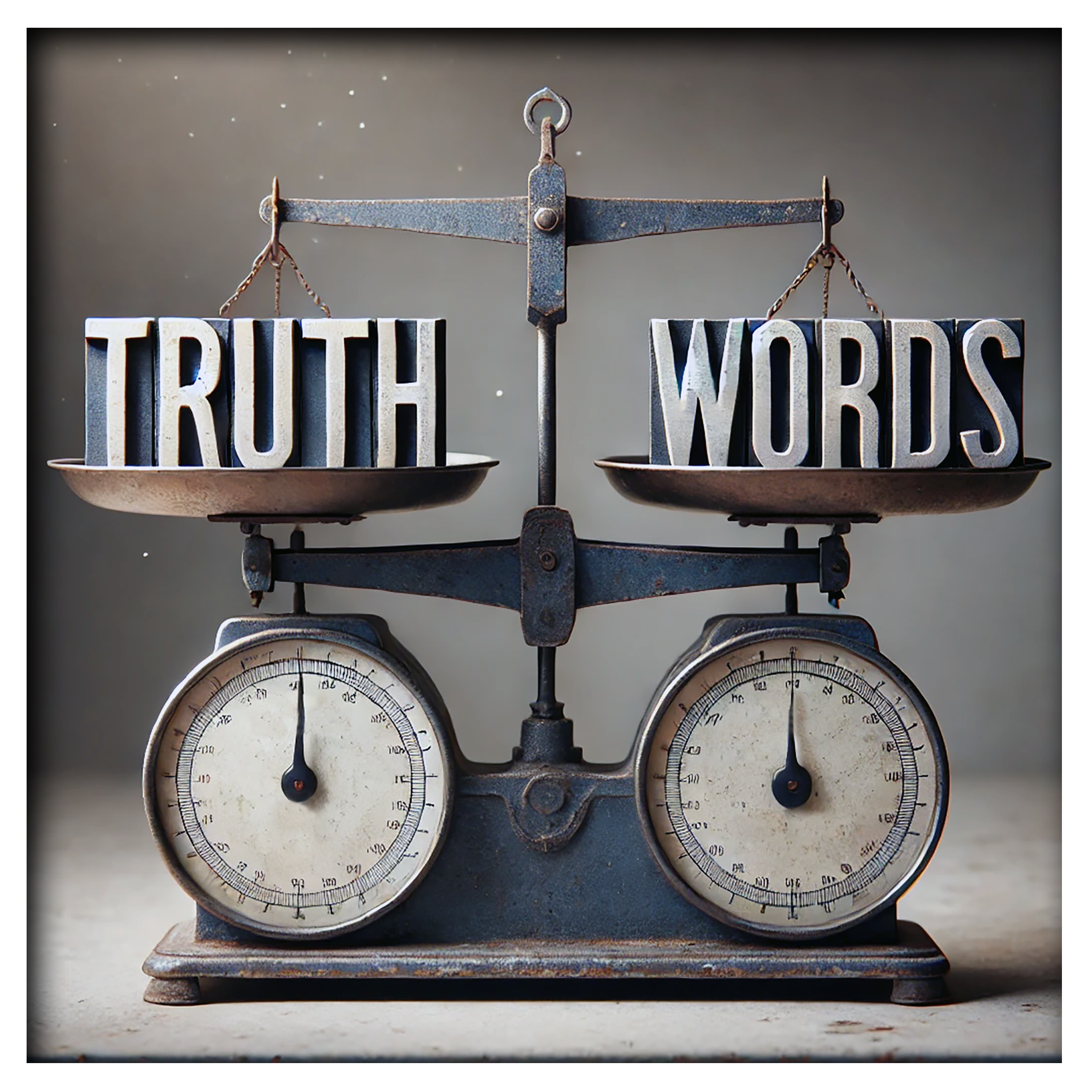
One of my first postings in this blog was a piece on the weaponization of words (Lexi-Con) that has been going on for quite some time. Over the years, words themselves have gone through a devaluation of sorts, whereby how we use them syntactically is of more importance than their contextual meaning.
This made me think of a childhood memory my beloved shared with me about a trip she made with her father to the bank. After only spending what felt like a few minutes, he was handed an envelope containing the money he wanted to borrow. As they left the bank, CeCe asked how he had gotten the money. “They know me here, so they opened an account for me.” No signatures required; no stacks of papers to review; no waiting period; no credit checks. Her father secured the funds simply for being who he was. More to the point, because her father’s character and his word were sufficient collateral.
A few people may find that hard to believe. Yet those of a certain age may recall a phrase that validates that experience: His word was his bond. Now, as tempting as it may be to focus on the use of the gender-based, third-person pronouns in that phrase, I would ask that you stay focused on the subject. The value of words has dropped significantly over the past few generations. With words being one of the most transacted commodities on Earth, why do we ascribe so little value to them?
For that, we have to look into the matter of trust. And for that, we first need to address the matter of truth.
For the sake of brevity, I won’t delve too deeply into this subject, though what follows may seem like a dissociated wormhole, and for that I do apologize. Suffice it to say that truthfulness, like an ocean, has varying degrees of depth. And although many of us have become acclimated to wading through shallow ponds of half-truths or little white lies, I don’t believe anyone has ever drowned walking through those benign puddles. But the consequences stemming from the intentional distortion or downright eradication of the truth reside in very deep waters, and swimming at such depths often imperils the chance for anything to survive.
To put it simply, truth is the vehicle that gives rise to faith. Trust is our pragmatic way of putting faith to the test. The more valid the truth, the stronger our faith in it and thus the amount of trust it engenders. From a secular and practical perspective (and without getting into any legal connotations), the trust we have in the truth we receive provides the ability for our conscience to accept it in good faith. Thus when focusing on context, the value – the essence of words delivered truthfully become the vehicle by which to express opinions, deliver thoughts, explore ideas, and begin the arduous but enlightened journey towards collaboration or compromise. Syntax without a frame of reference to underscore its mood, validity, or conviction is nothing more than a hammer that moves a belief or opinion forward by way of intimidation, fear, deceit, or indifference – the very antithesis of trust. In the course of everyday living, these basic tenets allow us to go about our daily lives doing simple things like crossing the street at a crosswalk, purchasing perishable items from a farmer’s market, or entrusting our vote to any one person who would be responsible for the safety of our very lives.
So when navigating that hypothetical ocean of truth where words appear to be cheap, how do you take someone at their word? When a person uses phrases like, I really mean it, I swear it’s true, or you’re not going to believe this, but…, what are they implying? Are these factual statements or challenges aimed at our trust? Are they meant to reiterate the validity of whatever truth was previously shared? Do we have faith in believing that people in general communicate honestly, or do so as a means to mix sincerity with subterfuge to embellish their social standing or simply cover their ass?
As we postulate the validity of anything we come to hear, see, or read, a fourth element comes into play: The element of time. Judging character takes time; deciphering the true meaning of any message takes time; realizing the consequences of our actions takes time. Yet the politics of time in today’s world are such that it’s a commodity most of us are no longer able to have, yet when we do, we simply waste it. William Penn was quoted as saying, time is what we want most but what we use worst. And yet how disturbingly fascinating it is to think that something as simple as a misspoken word or a statement delivered with an ounce of suspicion – something that takes mere seconds to deliver – can undo a lifetime of cherished beliefs, hard-fought sacrifices, and steadfast connections.
Incidentally, it’s an interesting side note that one of the definitions of politics states that it’s the activities within an organization aimed at improving someone’s status or position and typically considered to be devious or divisive. The underlining in that definition is mine; I thought it may help shed light on a connective thread somewhere.
In dealing with matters related to the value of words in any society, the essence of language is difficult to ignore. For when it comes to matters of truth, trust, or faith, the rhetoric of politics is deeply intertwined in the vocabulary of the community it represents. This is more readily apparent where the language of politics can reveal either the best elements of its nature or its most abhorrent. In a way, they become bonded to their words. So regardless of origin or outcome, in the search for meaning, the balance of truth is digested and disseminated by a community of people, and upon them falls the responsibility to gauge the manner in which language will be used to either defend or defer that truth, and what steps they will employ to sustain or proliferate the nature and the value of their beliefs. Eventually, these will be the choices, policies, and truths they will have chosen by which to live or die.


Leave a Reply