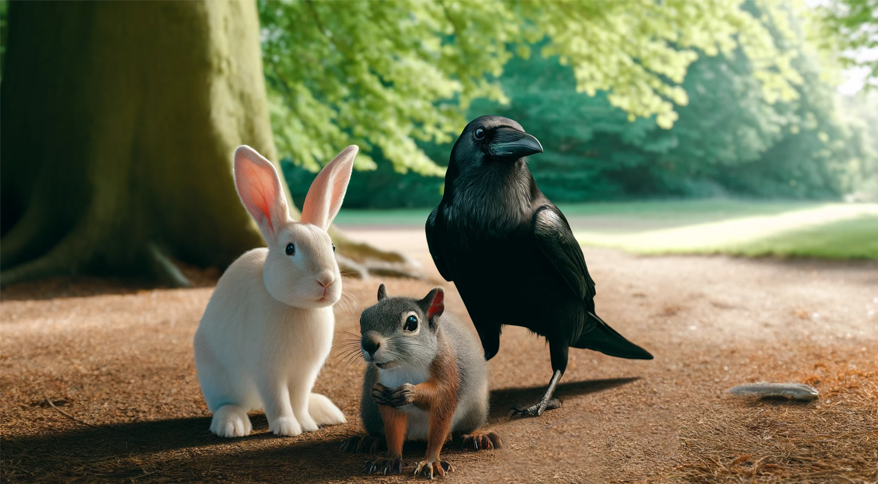
First off, let me just come out and say what is probably already on your mind: The title of this missive would make a great opening line for a joke. But this little story is based on actual facts involving a real squirrel, a crow, and a rabbit that happened to wander, waddle, and hop into our back garden.
We have three main bird feeders in our back yard. One of them is situated close to a small pond; it’s a perfect haven for frogs and an ideal watering hole for birds looking to wet their beaks – literally. There are a series of flat stones surrounding the pond that were fashioned into steps leading to a two-seater bench at the top of the garden’s gentle slope. These stones provide perfect surfaces on which to place additional seeds for the earthbound creatures to enjoy, giving birds a chance to relish the feeders uninterrupted.
I was looking out our kitchen window on this one particular morning, when I saw a crow make its appearance. We have two of them that frequent the back yard; we named them Russell and Sheryl. I assumed the visitor this morning was Russell. The next to appear was a rabbit whom we named Roger. The last (but by no means least) to join the impromptu backyard meeting was a squirrel with a huge, bushy tail. I named him Rocky, mainly because we were diehard Rocky and Bullwinkle fans.
As these three characters moved about, Rocky made no attempts to scare away Russell or Roger, even though Rocky has gone through great lengths in the past to scare away his genetic relatives. Russell kept waddling about while keeping an eye on Rocky and Roger, never displaying any alpha qualities. He would just waddle to a spot and eat; waddle to a spot and eat. Roger was a perfect gentleman, hopping about looking for his favorite scraps. Like Rocky, Roger was usually keen to drive away his familial relatives should they encroach upon his feeding area. However on this day, none of these visitors took steps to scare, bully or control the other. They just wandered about and ate in peace.
So why this story about a seemingly unimportant event? Why should we care about three animals (OK, two animals and one bird) doing what is in their nature? Because that’s the point of this missive – the nature of behavior.
When it comes to the animal kingdom, most people tend to generalize the behaviors exhibited by animals as only instinctual in nature; a hard-wired reaction inescapably tied to a fight or flight compulsion. After living on the farm for years and observing both the wild and domesticated creatures who inhabit this little piece of earth, I can say with a good deal of confidence that such generalizations tend to be full of equine road apples. In the case of the scenario I witnessed, each of the visitors was making a choice not to bother the other. They normally don’t get such choices. They live in a world where they are either hunter or prey and therefore do not have the luxury to let down their guard; like they did on the day I observed them. Granted, there may be some form of implied rules for foraging or staking out some small defined areas from which to eat. I am neither an ornithologist nor a zoologist, and I’m not about to posit about the behavioral patterns happening on that day. But I can speak about the members of my species.
Like our furry or feathered friends, we are bound by certain inherent tendencies that we employ for the sake of self-preservation. Yet when we are confronted by anything from an act of corporate malfeasance to a life-threatening event, we have the ability to make choices that define the actions we take and the eventual consequences we leave ourselves open to. Animals can be trained to counter their instincts in order to establish a working relationship or companionship with a human – or one another. It’s based on trust and the simple logic that when they befriend a human, they get rewarded. And that reward comes in many forms from food to shelter to companionship. So what about the nature of our behavior?
Despite the egocentric nature of our perceived placement on the King of the Hill list, we share many of the behavioral traits found in nature. That’s because we are a part of nature; a part of that ecosystem that is made of the same stuff, just arranged differently. We have it well within our nature to change; to bend and adapt for the sake of sustenance, shelter, companionship, procreation or knowledge (in lieu of or despite instinct.) Unlike our biological second cousins in nature that rely on the sum of their parts for the sake of the whole, we perceive the whole (aka us) as the more valuable component. I would posit that our attitude might change somewhat when one of the parts (say, the heart or brain) goes awry and the whole is, well, somewhat lacking. But the whole (with deference to Aristotle) is still greater than its parts because the whole becomes something more; something that as an entity has the power to effect change within nature.
Bottom line: We all have the ability to get along with one another; to collaborate for the sake of the whole. We just need to think about that visit from the crow, the rabbit and the squirrel. They chose to act despite their instinct and were rewarded with full bellies. I wonder what would it take for us to look beyond our instincts for the sake of trying to make a better world?
Leave a Reply