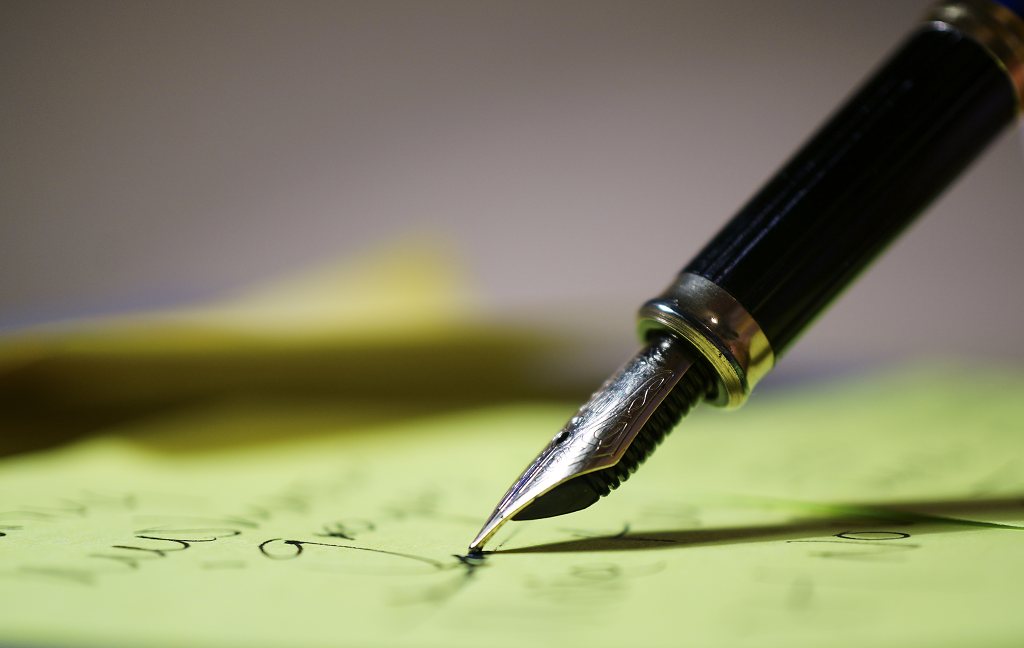
I’ve had a few dear friends and family members (not to mention my beloved) comment over the years about my writing abilities, and I am deeply honored and humbled by their observations. No, I’m not patting myself on the back for that. Those same good friends and family members would be more than happy to smack me out of that self-serving attitude. Instead, this is a heartfelt homage to the tools of my craft; a tribute to the power of prose.
I’ve been fascinated by words since I was very young, thanks to several writers in the family. I would listen to the adults around me speak and then observed how the words used elicited reactions, emotions and even actual physical movement. However this worked, I had to know more. How could something as simple as vocal utterances have such an effect on others?
Of course, I soon realized that words could be passed on; not just by talking but by writing. And don’t get me started on recordings. My sister used to be a radio disc jockey years ago, and part of her show was dedicated to playing records of comedians doing their routines. Every so often, she would bring the older ones home for us to play when friends or family would stop by for a visit. Once again, I was amazed at how people would sit around listening to the jokes and express such varied reactions just from listening to words. “A policeman pulls over a speeding driver: Where’s the fire, buddy? The driver responds: In your eyes, officer.” Funny and memorable stuff, for a kid.
My first serious foray into the impact of words came when I was about seven years old. One of my mom’s cousins was a writer with a couple of published books to her credit. We used to visit her from time to time, and although everybody would congregate in the living room or kitchen to chat, I could be found in her library. I would sit at her desk in a big leather swivel chair; a perfect vantage point from which to see all the books she had. Floor to ceiling, her bookcases were filled with all manner of books. I would grab a few to look at; most of the words were way over my head, plus many were in different languages. Nonetheless, I was in awe of their importance and significance. These were the ideas, insights and passions of countless human beings captured through the art of print. When done, I would carefully put each book back in its place, fearful that I might disturb some secret order that would cause disarray in that hallowed space. I have never forgotten that room. Years later, my beloved designed a library in our home for me to use, complete with a beautiful tuck and roll leather chair. For me, it is the most sacred room in our house because of the knowledge it holds (and yes, in various languages), but mostly because of her deep abiding love for me, her father and for the books themselves.
I had my first book published when I was about eight or nine years old (book being a very loose term.) My mom’s cousin took it upon herself to publish the first poems I ever wrote and made enough copies for the family. I cannot begin to tell you what that felt like. To hold a book in my hands that contained my words; words that would be around forever. But forever is a relative term, especially for a kid. And although all copies of that tome have since vanished, the image of that book and the effect it had on me was unmistakable and permanent.
Since time immemorial, our connection to the world and to each other has been intertwined by our ability to communicate. Through the use of art, symbols and even sounds, our earliest ancestors used tools to express the actions, experiences, challenges and triumphs of everyday life. These eventually paved the way to the development of cuneiforms and pictographs so we could express the nuances of human emotion and the subtleties of descriptive analysis. This evolution has been one of humanity’s greatest achievements and one that continues to this day, unabated.
But, back to words. There are few things created by human beings that have had a more profound effect on our personal, social, religious, spiritual, political, educational, recreational or even destructive thoughts and attitudes more so than words. They elicit all manner of emotions, thoughts, ideas, fears, comfort, laughter and understanding. A now famous piece of flash fiction written about 100 years ago (and once attributed to Ernest Hemingway) is a perfect example of the power that words can have on the human psyche: For sale: Baby shoes, never worn.
All jokes about the inflated literary prowess of William F. Buckley, Jr. aside, words are easy, fun, playful and the single most powerful weapon in our arsenal of communications. In a letter to Thomas Paine in 1796, Thomas Jefferson wrote: Go on doing with your pen what in other times was done with the sword: show that reformation is more practicable by operating on the mind than on the body of man. In 1839, the English author and playwright Edward Bulwer-Lytton would write a now-famous line for his play on Cardinal Richelieu: The pen is mightier than the sword. In my humble opinion, I believe that to be a lovely example of a good turn of phrase getting around.
I am often saddened to see how words have suffered as of late. The abbreviated requirements of modern textual communications have cut words to the quick. How RU; CU n 5; WTF. We’ve cut even the shortest of salutations or expressions to read like acronyms written by drunken cryptologists. We have opted to use words that are shorter or easier to spell because our educational system left the subtleties of linguistics and lexicology somewhere in a back room. People want to see less words yet gather more information. I suppose you could do that with recordings or videos. But as much as I love those two forms of communication, each of them still has its beginnings with words. Was it Helen of Troy’s face that, launched a thousand ships and burnt the topless towers of Ilium? That’s how the 16th century playwright Christopher Marlowe envisioned it, and it was his words that have forever ensconced that image of beauty in our minds for the past 436 years. WTF?
Learn to love words; treat them as your friends and stalwart companions. For nothing else provides a better description of you, nor can anything else ensure your legacy in this world. Pictures or paintings show our façade, but words reveal our soul. The most bombastic, visceral and effect-ladened movies about war may speak to its wholesale horrors. But what speaks to the human carnage of the individual dressed in gray or green? Siegfried Sassoon, the British war poet, soldier and World War I survivor wrote 106 years ago about this in his poem, Suicide in the Trenches:
I knew a simple soldier boy
Who grinned at life in empty joy,
Slept soundly through the lonesome dark,
And whistled early with the lark.
In winter trenches, cowed and glum
With crumps and lice and lack of rum,
He put a bullet through his brain.
No one spoke of him again.
You smug-faced crowds with kindling eye
Who cheer when soldier lads march by,
Sneak home and pray you’ll never know
The hell where youth and laughter go.
That solitary pathos won’t be on film, and pictures won’t quite do it justice. It’s that contextual gift that takes the emotions, memories, loves and losses from our soul and gives them life for others to read, understand and remember.
I know; I need to put a limit on these postings. Thank goodness that WordPress doesn’t restrict verbose writers like me (yet.) But I didn’t mind the time nor the length of this missive, and I hope you haven’t either. I wanted to write about the power of words and well, I need them to express their power and effect on an old fossil like me. But their magic has never wavered, nor have they ever left me in the lurch when I needed them most. They have shared my love, my losses, my thoughts, my excitement and my hopes with loved ones and all of you reading these posts. In a way, that little kid from long ago wasn’t entirely wrong. Words and the thoughts they carry can live forever. I thank words for their service; you should thank them for the gift.


Leave a Reply